Work Catalogs and Resources
This document describes the WFM planning model: what types of work exist, which skills are required, where work can be done, and which resources can execute it.
1. Business Meaning
WFM planning quality depends on four governance building blocks:
- work request catalog defines what can be planned,
- skills catalog defines what capabilities are required,
- address/zones model defines where work can be planned,
- work resources define who can execute and under which constraints.
These structures are reusable across many source processes and are typically maintained as master configuration.
2. Work Requests Catalog
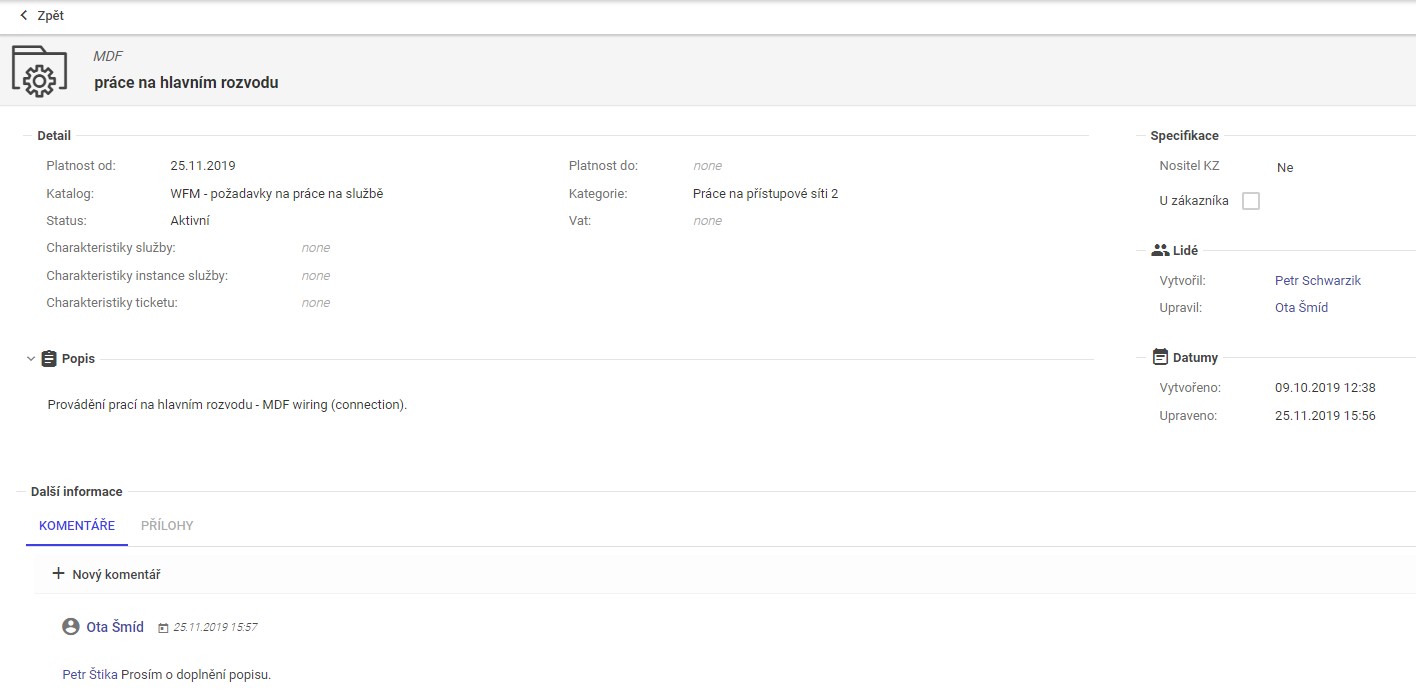
Work Requests Catalog is a full business/technical catalog of preconfigured field work types.
Business role:
- standardize inbound work demand,
- hold planning-relevant defaults,
- support lifecycle governance and documentation,
- provide API-compatible work definitions for internal/external systems.
Typical planning data on work request type:
- required skill set,
- expected duration,
- process/task template mapping,
- priority/due-date behavior,
- optional dependencies and constraints.
Work request list view:

Work request detail:
2.1 Modeling Notes
- work request catalog is usually categorized hierarchically,
- source systems reference catalog items when creating WFM orders,
- catalog entries can be used for both operational execution and long-term planning/reporting.
3. Skills Catalog
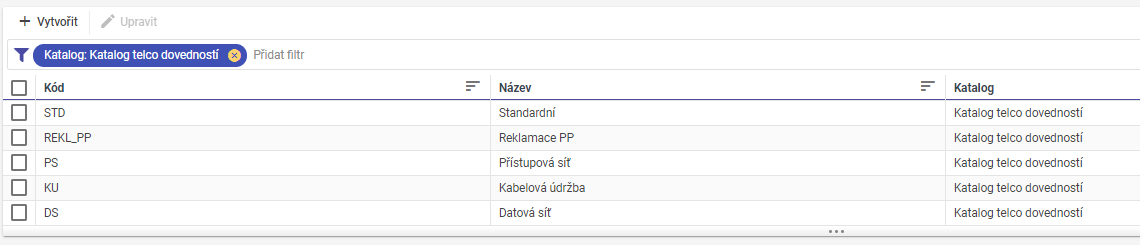
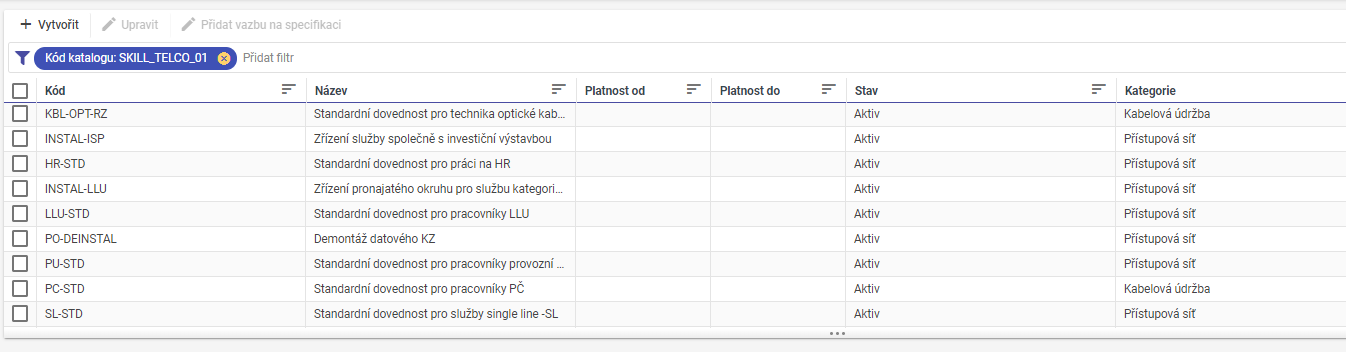
Skills Catalog defines capabilities required for field execution and enables automated matching between tasks and resources.
Business role:
- normalize skill taxonomy,
- prevent incorrect assignment,
- enable multi-skill and proficiency-based planning,
- support reporting on skill demand and capacity gaps.
Typical usage:
- tasks include required skills,
- work resources include owned skills,
- scheduler matches required and owned skill sets.
Skills catalog examples:
4. Address Management and Zones
WFM uses lightweight address and GIS capabilities in tSM to support field planning.
Core capabilities:
- address/place references for task location,
- hierarchical zone model (country/region/district/city/custom zones),
- map display and region editing,
- reverse zone lookup from GPS,
- optional integration to authoritative external address register.
Practical role in planning:
- constrain resource assignment by territory,
- support geofencing and scheduler partitioning,
- improve travel estimation and appointment quality.
5. Work Resources
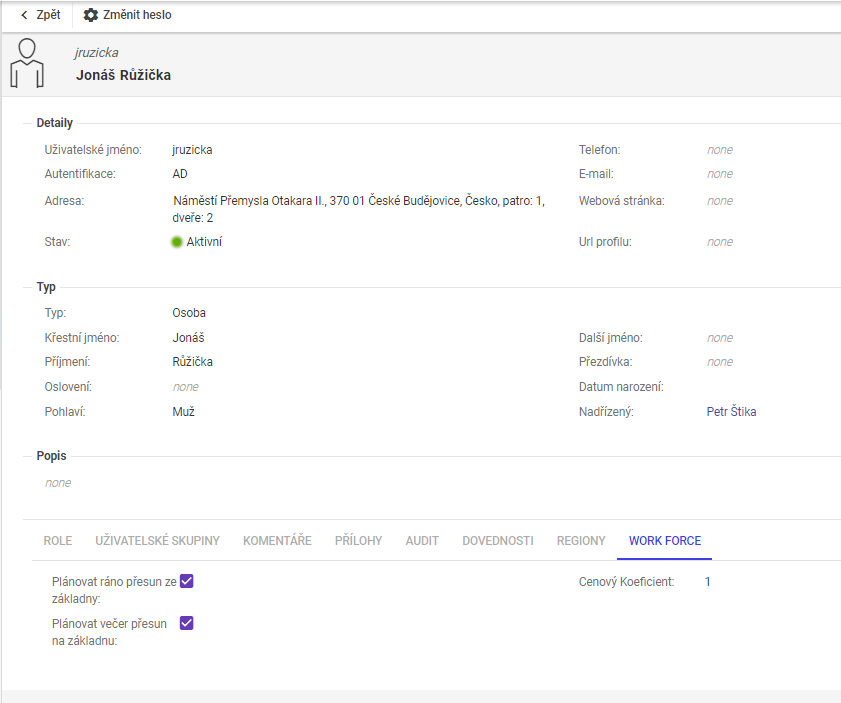
Work resources are modeled as extensions of the tSM user model.
5.1 Resource Types
| Resource Type | Meaning | Planning behavior |
|---|---|---|
| Technician | Single physical person | Planned individually based on skill/calendar/zone/cost |
| Workgroup | Group executing as one planning unit | Planned as one capacity entity |
| External company | Contractor capacity outside organization | Planned by contractual capacity; internal assignment handled externally |
5.2 Key Resource Attributes
| Attribute Group | Examples | Why it matters |
|---|---|---|
| Skills | skill list, optional levels | Feasibility filter for task assignment |
| Calendar | working hours, absences, interruptions | Time-window feasibility and optimization |
| Territory | assigned zones, base location | Routing cost and eligibility |
| Cost | cost coefficient | Optimization objective |
| Profile | standard/emergency mode profile | Fast behavioral switch for unusual conditions |
Work resource profile/configuration example:
5.3 Profiles and Mode Switching
- multiple profiles can be defined and assigned to users,
- only one profile is active for scheduling at a time,
- profile switching is used for emergency operations or temporary operating modes.
6. Planning Data Flow
7. Integration and Governance Notes
- keep catalog and skills ownership clear between business and operations,
- treat zone model as shared master data for WFM and related modules,
- govern profile changes and emergency modes through controlled operations policy,
- validate catalog/task/resource consistency before activating new work types.